This Is Not Just Another “Legal ChatGPT”
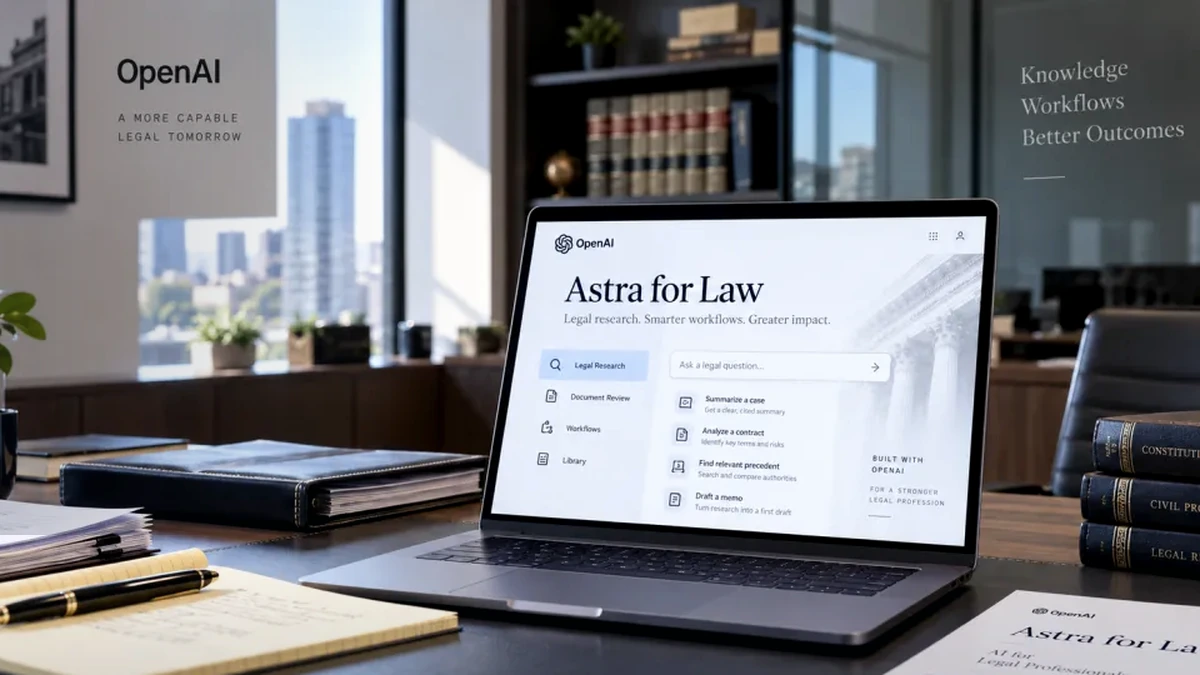
OpenAI introduced Astra for Law on September 17, 2026. It is not a wholly separate foundation model. Rather, it combines GPT‑6 Astra with a dedicated U.S. legal-search index, instructions tailored for legal analysis and writing, and a broader set of tools and controls intended for professional legal work.
That distinction matters. The competitive question in legal AI is increasingly not whether a model can draft a memo that sounds professional. General-purpose models are already getting much better at that. The harder question is whether the system can first retrieve the right authority, connect the facts of the matter, identify the passages that actually matter, and then move through the work in a way that resembles how experienced lawyers operate.
The Search Layer Is More Important Than It Looks
Astra for Law’s Legal Search Index covers U.S. case law, statutes, regulations, court rules, and administrative decisions. OpenAI says the index spans more than 230 million URLs and is updated with new sources daily. It also incorporates CourtListener case-law data from the Free Law Project.
That may sound like “better search,” but legal research is unusually sensitive to retrieval quality. The problem is not simply whether a model can produce fluent analysis. It is whether it can locate the authority that should be read, find the relevant passage, understand the jurisdictional and precedential weight of the case, and surface adverse authority that weakens the initial position.
The logic is simple: better legal writing is not very useful if the research layer starts from the wrong cases.
The Benchmark Numbers Are Interesting—but Need Careful Reading
OpenAI reported results on 200 U.S. legal-research questions drawn from the private validation set of Vals AI’s Legal Research Bench. At the highest reasoning effort, Astra for Law passed the benchmark’s overall correctness check on 54.0% of the questions, compared with 38.7% for GPT‑6 Astra using ordinary web search—a relative improvement of about 40%.
OpenAI also reported that, on case-law-focused questions, Astra for Law found 24% more reference cases and, in an audited set of target passages, retrieved up to 54% more relevant passages from the correct court opinions.
These are OpenAI-reported results on a private validation set of 200 specific legal-research questions. They are evidence about this benchmark setup, not a universal measure of whether Astra for Law is “54% accurate” at legal work.
That caveat matters for another reason: the result itself shows how far legal AI still is from a “hand it over and stop checking” workflow. The more professional the task, the more important source verification and human review remain.
The Bigger Shift Is from Documents to Workflows
The more consequential part of the launch is what OpenAI is doing with law firms around workflow design.
OpenAI described firm-specific tools created with forward-deployed engineers on top of ChatGPT Enterprise. Sullivan & Cromwell built an agreement-analysis workflow that brings the firm’s negotiating playbooks and selected precedents into the review of a new transaction. Ropes & Gray built a deal-diligence system structured around how lawyers work through a data room and decide which issues matter to the deal. Cooley developed an IPO-preparation workflow that applies capital-markets experience to drafting, risk identification, and document updates as the transaction changes.
These examples should not be confused with out-of-the-box Astra for Law features. The point is different: law firms are starting to convert their own historical precedents, methods, escalation rules, and professional judgment into repeatable AI-supported workflows.
What Is Entering the AI System Is Institutional Judgment
For years, much of a law firm’s real operating knowledge has lived in senior lawyers’ heads and in the accumulated habits of teams.
Which clause deserves special attention? Which fact should trigger another question to the client? Which risk should be escalated? Which precedent should be used as the starting point? When is an apparent issue actually immaterial? How was a similar transaction handled before?
The next generation of legal AI is increasingly about making those patterns explicit enough that a system can call them back in a controlled way.
The Same Logic Applies to Patent AI
This is where Astra for Law becomes particularly interesting for patent practice.
Future patent AI will not be differentiated only by whether it can draft an Office Action response. General models will become increasingly good at producing language that looks like a professional patent filing. The harder and more valuable layer is whether the system can connect to a team’s accumulated way of handling real matters.
For a §103 obviousness rejection, that means going beyond summarizing D1 and D2. A practitioner-grade workflow may ask:
- Are the references actually within the relevant prior-art field?
- Is there a legally and technically credible motivation to combine?
- Does the proposed combination produce the technical relationship required by the claim?
- Is there a reasonable expectation of success?
- Does the proposed amendment have specification support?
- Would the amendment solve the immediate rejection at the cost of commercially important scope?
For FTO, the same system should know when a claim chart is not enough: when prosecution history should be retrieved, when related family members matter, and which product facts must go back to engineering for confirmation.
These are not simply “smarter language model” problems. They are workflow and judgment problems.
Governance Is Part of the Product, Not an Afterthought
Astra for Law also highlights another point that becomes more important as AI moves deeper into high-value legal work: governance.
OpenAI’s current materials describe access through a Trusted Access model for selected firms and emphasize controls for confidential legal work. The company is also working with law firms on questions such as information permissions, ethical walls, client instructions, and internal oversight.
Once AI can reach deeper into firm systems, the questions extend well beyond “Will the model hallucinate?” Lawyers also need to ask:
- Which client materials can the system see?
- How are matters and clients isolated from one another?
- Who is authorized to invoke a workflow?
- How can a conclusion be traced back to the source?
- Who is ultimately accountable for the work product?
If those questions are not answered well, even a very strong model will be difficult to trust in sensitive legal work.
Professional Value Moves Up the Stack
The broader lesson is that legal AI may change how professional value is measured.
The differentiator may increasingly be less about how many pages a lawyer personally drafts in a day and more about whether that lawyer knows which authority can be trusted, which risk deserves escalation, which evidence must be rechecked, which question should be asked next, and where the system must return to primary sources before anyone relies on the answer.
That is why I see Astra for Law as more than another legal AI launch.
The Takeaway
The next phase of legal AI is not just about generating text.
It is about turning years of professional knowledge, tools, workflows, and judgment into systems that can be reused—while still remaining controlled, auditable, and verifiable.
For law firms, patent teams, and other professional-service organizations, that may prove to be a much larger change than better drafting alone.