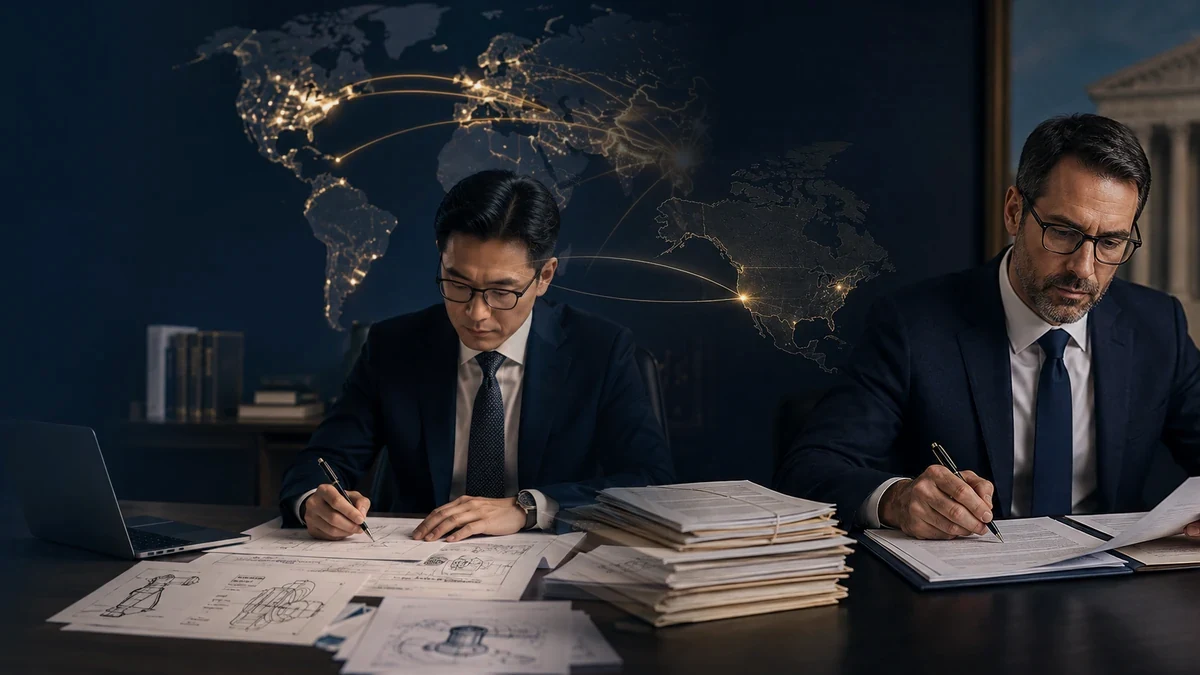
Why the Traditional Two-Party Model Can Become Strained
Many Chinese IP firms are strong where they have spent years building capability: client relationships, business development, Chinese patent drafting, inventor communication, and day-to-day portfolio management.
The pressure often appears later, when a China-origin case moves into a foreign patent system. A U.S. Office Action may require not just English drafting but an understanding of U.S. claim construction, §102/§103 reasoning, §112 support, prosecution history, and the practical way arguments are framed before the USPTO. EPO practice has its own logic, terminology, and procedural expectations.
At that point, the Chinese firm must decide how much work to keep in-house and how much to send abroad. That choice affects cost, quality, turnaround time, and—often underestimated—the client relationship itself.
The Three Common Options
1. Build the capability in-house
A firm can recruit experienced cross-border practitioners and develop a dedicated foreign-patent team. For organizations with steady volume, that can make sense. For smaller firms or practices with uneven foreign-filing demand, however, the fixed cost and retention risk can be difficult to justify.
2. Send the matter directly to foreign counsel
This is the conventional model and remains essential because local counsel must make the jurisdiction-specific legal judgments and, where required, sign and file the papers. But direct outsourcing does not solve every operational problem. The foreign lawyer may receive a file that is technically incomplete, poorly translated, internally inconsistent, or missing the commercial context behind the client's instructions. The Chinese firm may also find it difficult to evaluate a sophisticated English draft after it comes back.
3. Add a specialized backend layer
The third model inserts a technical and drafting layer between the China-side client team and the foreign lawyer. The purpose is not to create another gatekeeper. It is to make the handoff better.
The Chinese firm continues to manage the client and define the commercial objective. The backend partner works through the technical record, claim structure, prior art, translation, amendment support, or response logic. Qualified foreign counsel then reviews that material, applies local law and professional judgment, and decides what should actually be filed.
Chinese IP firm: client relationship and business objective. China-side backend: technical depth, bilingual analysis, and draft support. Foreign counsel: local-law judgment, professional supervision, signing, filing, and final responsibility.
What the Backend Layer Actually Adds
Good backend support is more than translation and less than acting as local counsel. Depending on the matter, the work can include:
- reviewing the Chinese specification and claims before foreign filing;
- identifying technical ambiguities, terminology drift, or support problems before they become prosecution problems;
- preparing bilingual claim charts, prior-art comparisons, and technical issue lists;
- developing an Office Action response framework or amendment alternatives for counsel review;
- reworking China-origin patent text so that the technical disclosure is easier for U.S. or European counsel to use;
- supporting FTO, infringement, validity, and design-around analysis at the technical and claim-mapping level;
- explaining the client's technical priorities and the reasons behind particular drafting choices.
This can reduce the amount of foreign-counsel time spent reconstructing a file from the beginning. More importantly, it can improve the quality of the questions that reach counsel. A well-prepared file allows the foreign lawyer to spend more time on the legal decisions that actually require local qualification and judgment.
What the Backend Layer Must Not Become
This model fails if the backend provider becomes a hidden competitor for the front-end firm or starts blurring professional roles.
For CrossVision IP, the boundaries are deliberate: I do not sign or file papers before the USPTO, EPO, or other foreign patent offices in my own name; I do not replace qualified local counsel's legal judgment or supervisory responsibility; and I do not contact or develop a partner's end client without authorization.
That is not a limitation to work around. It is part of the value proposition. The relationship is more stable when everyone knows who owns the client relationship, who performs the technical work, and who carries the local professional responsibility.
Why This Matters to Foreign Counsel
For an overseas patent firm, China-origin work often arrives through a relationship rather than through an open-market search. A Chinese agency or practitioner needs someone they can trust in a particular jurisdiction, technology area, or type of matter. Price matters, but it is rarely the only variable.
What they are really evaluating is whether the foreign lawyer will be responsive, technically engaged, commercially sensible, and respectful of the originating firm's client relationship.
A China-side backend partner can help on both sides of that equation. It can help the Chinese firm formulate a better instruction package before the matter goes abroad, while also helping foreign counsel understand what the Chinese practitioner and end client are actually trying to achieve.
That makes the relationship less transactional. Instead of every new matter beginning with basic reconstruction, the participants gradually develop a shared working language, templates, expectations, and quality standards.
The Referral Relationship Usually Starts Before the Referral
There is another reason I think this model matters.
Through CrossVision IP and the professional community around 跨域知见, Chinese patent practitioners regularly ask me which overseas patent firms or practitioners I know and trust when they need local representation. I do not act as the foreign agent in those matters. But being on the China side of the professional network means I am often in a position to know what kind of overseas support colleagues are looking for.
That is one reason I am publishing more of this work in English. When a real referral need appears, it is much better to already know the people behind a firm—their practice strengths, communication style, fee approach, and attitude toward originating counsel—than to start searching from zero.
For foreign practitioners, that also means visibility in China does not have to begin with advertising to end clients. It can begin by building credible professional relationships with the Chinese practitioners who are already trusted by those clients.
Trust Is the Operating System of the Three-Layer Model
The economics of cross-border work matter, but trust is what determines whether the model lasts.
The Chinese firm needs confidence that its client relationship will not be bypassed. Foreign counsel needs confidence that instructions are serious, information is organized, and the China-side team understands the limits of its role. The backend partner needs to be useful to both sides without trying to own either side's position.
When those incentives are aligned, the three-layer structure is not extra complexity. It is a way to remove the wrong kind of complexity from the file.
Takeaway for Overseas Patent Firms
If your practice handles China-origin patent work, the opportunity is not only to be the lawyer who receives the next filing instruction. The more durable position is to become a foreign professional whom Chinese practitioners already know, understand, and feel comfortable recommending.
My own role is on the China side: patent analysis, bilingual technical work, draft support, and professional connection. I am interested in getting to know overseas patent lawyers and firms that value long-term referral relationships, clear role boundaries, and technically serious collaboration.
If that describes your practice, the For Foreign Counsel page explains how CrossVision IP works with overseas practitioners, or you can contact me directly.
Original Chinese Article
This English article is an editorial adaptation of the Chinese-language article “国内所嫌贵,海外所怕丢客,后端在中间能做什么” published through 跨域知见. Read the original on WeChat.